
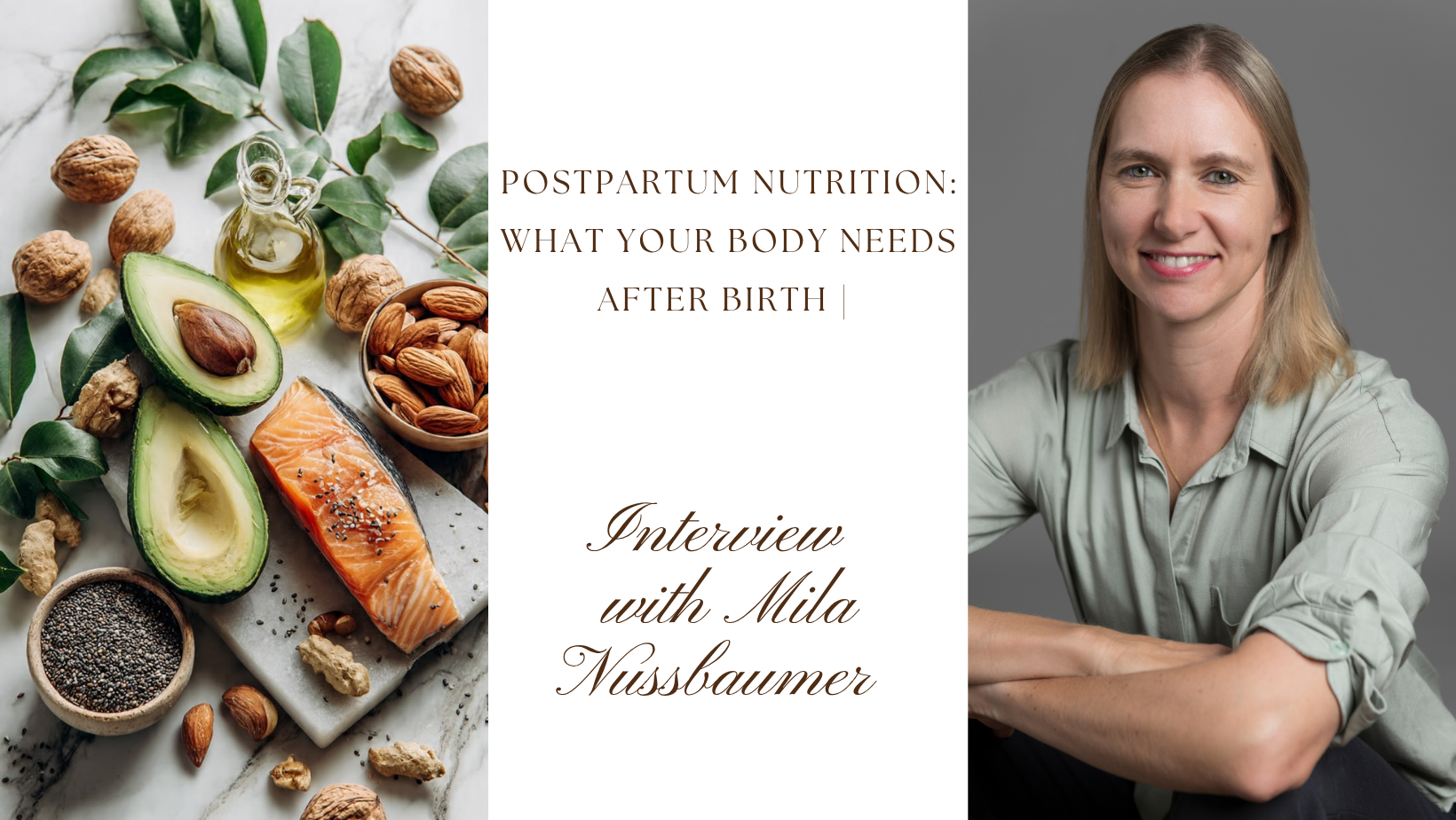
Postpartum Nutrition: What your body really needs after birth
The postpartum period is a time of enormous physical and emotional change. After months of pregnancy and the experience of giving birth, your body needs time, nourishment and care to recover — while you are simultaneously learning how to care for a newborn.
Yet conversations around postpartum health often focus on getting back to a pre-pregnancy body, losing weight or “bouncing back.” But people forget about feeding and supporting the body that has just done something extraordinary.
As part of our new interview series exploring postpartum care and the professionals supporting mothers during this important stage of life, today we’re talking about postpartum nutrition.
Our guest is Mila Nussbaumer, a certified nutrition coach (SAFS) from Baden, Switzerland, and the founder of Bloomkraft. She supports women through two major body transitions where standard nutrition advice often falls short: the postpartum period and the years around 40.
Her path into this work started with her own postpartum experience. As a lifelong athlete, Mila thought she had nutrition figured out — until she became a mother and realized that none of the usual programs really fit her body or her new life.
Today, she combines nutrition and mindset coaching, working with women 1:1 both online and in person. Her philosophy can be summed up in one line: no calorie counting, no forbidden foods and no guilt. Instead, she focuses on understanding what a woman's body needs in different phases of life and building eating habits that can actually work in real life — including life with children.
In this conversation, we talk about what the body needs after birth, the importance of adequate nourishment, common nutritional challenges new mothers face, breastfeeding and nutrition, easy ways to eat well when you have very little time, and why postpartum recovery should be about nourishment rather than pressure to “get your body back.”
So, let's hear from Mila.
1. What are the biggest nutritional needs in the first 6 weeks postpartum that most women underestimate?
The most underestimated need is the simplest one: enough food. Healing costs energy. Your body has just done something extraordinary, and it repairs tissue, rebuilds the pelvic floor and restores depleted stores only if it gets enough fuel. Many women instinctively eat less because of the pressure to "get their body back", at exactly the moment their body needs more. The second thing most women underestimate: how empty their stores are. Iron (especially after blood loss), vitamin D, B12 and omega-3 are the most common gaps, and they feel like "just baby exhaustion" when they are actually fixable. My simple rules for those first weeks: a portion of protein at every meal, nutrient-dense foods over empty calories, and a water bottle within reach wherever you sit.
2. How does nutrition differ for breastfeeding vs. non-breastfeeding mothers?
Producing milk costs roughly 400 to 500 extra calories a day, so a breastfeeding mother needs more of everything: energy, fluids, and a few key nutrients like iodine, vitamin D, B12 and iron. The reassuring part: your milk stays nourishing even when your day was chaotic. If anyone runs empty, it is you, not the baby. That is why my focus with breastfeeding mothers is "enough" rather than rules. And most of the classic rules are myths anyway: for most babies, beans and cabbage in your diet are fine, and one or two coffees a day are usually no problem. A non-breastfeeding mother has the same healing needs without the extra energy demand. For her, the focus shifts fully to refilling the stores that pregnancy and birth emptied.
3. What role does nutrition play in postpartum mood, energy and recovery, including C-section healing?
A much bigger one than most people think. Blood sugar stability is mood stability: meals built on protein and fiber prevent the crash-and-crave rollercoaster that sleep deprivation makes so much worse. Iron and B12 gaps can look exactly like depression or "normal" exhaustion. Omega-3 supports mood and is passed on through breast milk. After a C-section, your body is healing major abdominal surgery on top of everything else, so protein and sufficient energy are non-negotiable; undereating literally slows wound healing. One more thing I always mention: if the exhaustion feels bigger than "tired with a baby", have your thyroid checked. Postpartum thyroid problems are common, often triggered in the months after birth, and they are missed all the time because the symptoms look like normal new-mother fatigue.
4. What does "eating well" realistically look like for a mother with little time and low energy, and what should she stock before birth?
Eating well postpartum means 80% good enough, not 100% perfect. The anchor is breakfast: something with protein that carries you, like quark or skyr with berries and nuts, or eggs. Then one-hand snacks within reach: nuts, cheese, hard-boiled eggs, hummus with vegetables. Before birth, I recommend stocking things that become a meal in five minutes: frozen vegetables, canned lentils and beans, oats, eggs, nut butter, and ideally a few pre-cooked soups or stews in the freezer. And if a day goes completely sideways: one solid meal is a win. Tomorrow is a new day.
5. How do you help mothers who feel guilty about not "eating perfectly"?
I tell them that guilt is the least useful ingredient in any kitchen. Nobody heals better because she feels bad about a granola bar dinner. The reframe that helps most: speak to yourself the way you would speak to a friend who just had a baby. You would never tell her she failed because she didn't cook. The goal was never perfection; the goal is being nourished enough to heal and to enjoy your baby. That is also why I work without food rules: rules create guilt, and guilt creates the exact eating patterns women want to escape. A plan you live 80% of the time beats the perfect diet you abandon after ten days.
Check up Mila's website on the link below:
or
Y
ou might also like to read the following posts:
→ "How to support your partner after having a baby"
→ "The First 6 Weeks: What to Expect After Birth"
/ Polina